|
Hanging
on the second floor of the 1855-vintage Neill-Cochran House in Austin
is an oil painting credited with doing what even high-priced lobbyists
can't always accomplish - swaying the Texas Legislature.
The significance of the piece of art goes back to the turn of the
last century, when Texas lawmakers departed from their usual weighty
deliberations to ponder what native plant should be designated the
official state flower.
Rep. John Nance Garner of Uvalde thought the prickly pear cactus
deserved the honor. As tough as Texas, the thorny plant produced
a flower the future Vice President considered as beautiful as any
orchid.
Cactus Jack's notion of having a cactus as the state flower earned
him a colorful nickname, but no cigar. The idea definitely got under
Rep. Phillip H. Clements' skin. To the Goldthwaite legislator's mind,
nothing would do but to name the cotton boll -- he called it
the "white rose of commerce" - as the official state flower.
But
with all due respect, the ladies of the Colonial Dames took Garner
and Clements both for blooming fools, as least when it came to Texas
flora. The Dames argued that any real Texan realized that only one
flower truly represented the beauty of the Lone Star State, Lupine
subcarnosus. |
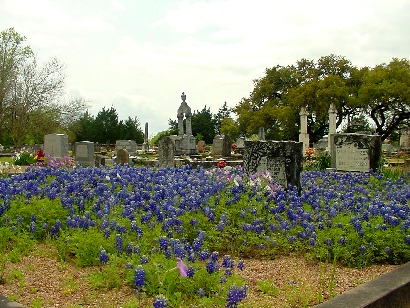 |
Bluebonnets in
Fayetteville Cemetery
TE photo,
2003 |
To underscore
their opinion, members of the Austin chapter rode in their buggies
to the Capitol and displayed for the members of the House an oil painting
by a local woman, Mode H. Walker.
The piece features a reddish-brown pitcher full of bluebonnets and
primroses. The blue and pink brush strokes still catch the eye, an
artful rendering in a genre often cluttered with amateurish work.
Walker's painting clearly got the attention of the House. Oh, and
the sweet-smelling bouquets of bluebonnets the Dames placed on each
lawmaker's desk also helped make their case.
Rep. John Green of DeWitt
County carried the bill making the bluebonnet the Texas state
flower and it passed. Gov. Joseph D. Sayers signed the measure into
law on March 7, 1901.
So who was this artist whose work influenced the
Legislature as effectively as a high-powered lobbyist armed with campaign
contributions, a hospitality suite and 50 yard line University of
Texas football tickets?
"Once a while back," says Neill-Cochran House Museum administrator
Cecille Marcato, "I poked around looking for information on Mode Walker
and couldn't fine anything."
Indeed, a google.com search turned up no more on Miss Walker than
the fact that she had done the opinion-swaying bluebonnet painting.
Though little information on Miss Walker seems to have survived the
intervening century-plus since she completed the influential still
life, the painting has endured. Mr. and Mrs. Pierre Bremond donated
the oil to the Neill-Cochran House Museum in 1985. (Located at 2310
San Gabriel St., the house is open for tours.)
While
Walker's painting has been credited with convincing the Legislature
that bluebonnets deserved official status, Marcato says there's another
oil painting connected to the issue. It's a bluebonnet landscape by
Julian Onderdonk once owned by Mrs. Sawnie Robertson, one of the Dames
who took part in the campaign to gain recognition for the wildflower.
In commemoration of Mrs. Robertson's role in achieving official standing
for the bluebonnet, her granddaughter presented the painting to the
Governor's Mansion in 1980.
Even though the Dames succeeded in transforming the bluebonnet into
an official Texas icon, the 1901 law had a loophole big enough to
walk a cow through: The statute specified Lupinus subcarnosus as the
state flower even though Texas has other varieties of Lupinus.
Not until March 8, 1971 did the Legislature return to the bluebonnet
issue, finally amending the law to add Lupinus texensis and "any other
variety of bluebonnet not heretofore recorded." |
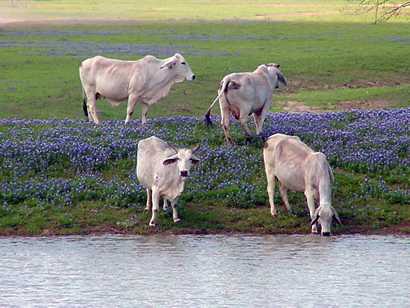 |
Bluebonnets Brahma
Cows west of Conroe
TE photo,
2006 |
|
|
 HOME
HOME