|
Back
when I was still working full time for The Gonzales Inquirer
newspaper, I would often spend my weekends going through the
archives and researching some of the old papers.
Sometimes I would just decide to pick a year, and then go through
every issue from that time period. The last one I researched was
1961. I really don't know why I picked that year — maybe because
that was when I graduated from high school — and most of the memories
from that time are good ones.
However, an old Inquirer from September 14, 1961, reminded
me of one of the bad memories — one I had all but forgotten.
The story was from the Associated Press (AP) wire service
and it was titled: "15-Year-Old Boy Describes Loss Of Family In
Storm." And what triggered the bad memory for me was; I knew that
boy. As I recall, he and my sister were classmates and friends.
The young boy's name was Robert Dunn and his life was indeed a tragic
story.
When
Hurricane Carla crashed ashore on the Texas
coast on September 10,1961, I was in the Texas Army National
Guard and was going to the Army's armor training school at Ft. Knox,
Kentucky. My family lived in Angleton,
Texas. Robert Dunn and his family lived south of Angleton,
along the banks of Bastrop Bayou.
According to old weather records, Carla had grown so large by September
9, that it enveloped the entire Gulf of Mexico — winds near the
center were estimated at 150 mph. On that day a mass evacuation
was ordered. It was reported that over half a million coastal residents
fled the storm. This early evacuation greatly reduced the number
of lives that were lost; records show that 46 died in the storm.
Eleven of those who perished were from Robert Dunn's family. This
number included members of his uncle John Drvar's family.
Robert's father, R.W. (Shorty) Dunn, felt as if he had been through
several storms
before and he really wasn't too concerned about this one. Local
authorities begged him to leave because his home on Bastrop Bayou
was in grave danger. He refused to be evacuated. He was asked to
let his children come out and again he refused.
When I returned to my National Guard unit in Angleton,
several months after the storm, I talked with several of my buddies
who were sent out to try to rescue the Dunns.
The guardsmen said they made three attempts to get the Dunn family
out. On the third try, they lost a two and a half ton truck in Bastrop
Bayou. The driver told me that when they reached a bridge, only
one guardrail was sticking out of the water. He had to pick one
side or the other, hoping to pick the one with the bridge underneath.
His selection was wrong and several soldiers nearly drowned. That
was the last attempt to rescue the Dunns.
In the AP story,
Robert Dunn said that his father felt that he had been through storms
before and Hurricane Carla would be no worse than the others.
The article quoted Robert's description of the event: "He said if
it got too bad we would leave," Robert said. "My aunt and uncle
lived close to us and when it got pretty bad they came to our house."
"What must have been a tidal wave suddenly covered everything, including
the car, and we couldn't leave. Somehow we made it to the attic.
All the food we had was a loaf of bread. My share was two slices,
but two of the younger children were crying because they were so
hungry and I divided my share among them. I didn't feel hungry anyway.
"I think it was early Sunday morning that we got into the attic.
We stayed there until the worst part of the storm hit. There was
a big wave that came then and we all started to get on the roof.
I managed to get up there.
"The wind was blowing really hard then and I tried to reach down
and help two of the children up. But something seemed to pull them
away from me.
"The last time I saw my parents, mother and dad were holding hands
and she was crying."
Robert Dunn was on the roof of his floating home for three days.
When the house finally came to rest on land, he walked out. Robert
told me that he thought he was miles out in the Gulf of Mexico because
he was surrounded by water. He said he even saw a buoy with a red
light on top. What he actually saw was the radio antenna above the
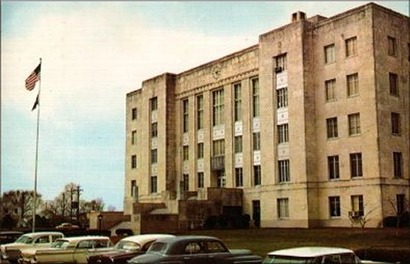
Brazoria
County Courthouse. The courthouse is five-stories tall.
|
 HOME
HOME