|
|
I
remember
the first time I heard Kris Kristofferson sing. It was in San Francisco,
early 1970s, my husband Richard, son Richie and I were visiting my
brother, Tom McEvoy and his soon-to-be wife Joanie, in his apartment
on California Street a couple of blocks above Fillmore Street. It
was a colorful "happening" area.
"I want you to hear this," Tom said placing an LP on the stereo.
Chit chat stopped as we settled back listening to this guy named Kristofferson
singing his own songs: Help Me Make It Through The Night, Casey's
Last Ride, Sunday Morning Coming Down, Darby's Castle, Me And Bobby
McGee, For The Good Times. |
|
|
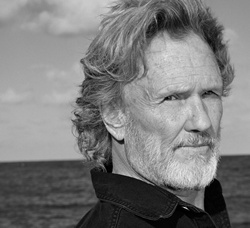
Kris
Kristofferson
Courtesy Kris Kristofferson |
Radio
had been playing stellar versions of some of these songs by artists
such as Sammi Smith, Ray Price, Roger
Miller and Ray Stevens. Kristofferson's rough as tree
bark voice was nothing like Price's smooth tone or Smith's sultry
delivery. Yet there was something immensely compelling about his straight
from the heart honesty that slammed into San Francisco sophisticates
and this Texas country girl, with equal force. We all sat mesmerized,
staring at the floor and sipping drinks, feeling the stories we were
hearing: the emptiness in Casey's life, the sorrow in the ruins of
Darby's Castle, and the loneliness of a Sunday morning sidewalk.
My brother Tom was tending bar at Harpoon Louie's, a busy downtown
club that has long since faded from the scene. Loud music and the
din of voices from elbow to elbow crowds of the beautiful and upwardly
mobile were a natural part of his work day. The simplicity in Kristofferson's
songs made a bridge to quiet time after the sensory overload. Thirty
five years later the songs are still here, having made the journey
from vinyl to 8 Track to CD. Kristofferson has grown into an entertainment
icon of gigantic proportions, and my brother and I have traveled more
roads than we ever imagined, but those songs continue to get cued
up in my CD player occasionally. In this increasingly noisy world,
they are still a bridge to quiet time.
We
knew nothing about Kristofferson then. We would come to learn that
his life was far more interesting than any song he could ever write.
Perhaps that's why he had to write them. His story is well known,
born in Brownsville,
Texas, son of an Air Force General, family moved to California,
attended Pomona College, apparently excelling in everything he attempted.
He lettered in football, was a Golden Gloves boxer, Phi Beta Kappa,
won awards from Atlantic Monthly for creative writing, a Rhodes Scholarship
took him to Oxford University in England to study literature. Military
life, a family tradition, was always hovering in the wings and he
joined the army after Oxford, served as an Airborne Ranger helicopter
pilot, attaining the rank of Captain, got married, started a family,
and was offered a position teaching English Literature at West Point.
It was a story book life…well planned, well executed with all the
makings of a, they all lived happily ever after, ending. Except, of
course, they didn't all live happily ever after. At least not right
away.
Kristofferson took a 180 degree turn and moved to the country music
capitol Nashville, Tennessee to begin at the bottom in an industry
that is seldom kind to newcomers. Looking backward, it's easy enough
to see he had too much talent not to explore it. But it was a tremendous
step down from the prestige of West Point to a janitor's job at Columbia
Records on Music Row, although it was not as crazy an idea as it might
have seemed. It put him in contact with music people and he would
actually get some of them to listen to his songs…eventually. With
his skill as a helicopter pilot he also earned money flying workers
to and from off-shore oil rigs, so he was not quite as down and out
as some biographies have painted him. Still it was a trying time personally
and professionally.
It must have taken a lot of courage to do that, I commented in a phone
interview with Kristofferson many years later.
"It was a matter of survival, not courage," he said. "And it was the
most selfish thing I could have ever done. A lot of other people,
my wife and kids, had to pay for it. But I would be dead if I had
not done it."
He indicated that whatever might have been broken then has long since
been mended:
"I feel really fortunate that that has all worked out well, the relationships
I mean. My kids all love each other and I'm on speaking terms with
all my ex-wives," he added.
He said two of his heroes before he came to Nashville were Willie
Nelson and Johnny Cash. He would meet and become life-long
friends with both, as well as Waylon Jennings. They would record
and tour as The Highwaymen and make movies together. It was Cash,
he says, who introduced him at the Newport Folk Festival and encouraged
him to begin performing.
There
was another important songwriter in Nashville in the 60s, a Houston,
Texas lad by the name of Mickey
Newbury... next page
© Dorothy
Hamm
"Words and Music"
Column -
June 8, 2006 column |
|
|
 HOME
HOME