Million Barrel
Hole by Mike
Cox
One
of Texas’ most impressive engineering feats is nothing but a hole
in the ground today, an idea that tanked big time.
In 1928, however, anything seemed possible. The newly discovered
Hendricks field in Winkler County spouted 500 barrels a day and
places like Pyote,
Monahans and Wink
became what one newspaper called “mushroom towns.” The only thing
rising faster than the available supply of crude was the price it
fetched.
Unfortunately, the Roxana Petroleum Company (later absorbed by Shell
Oil) did not have a pipeline to get all that oil to a refinery.
And hauling the crude to the nearest rail connection by truck over
mostly unpaved roads would take a fleet of vehicles.
To solve the problem, the company decided to build a Texas-size
reservoir to hold the black gold.
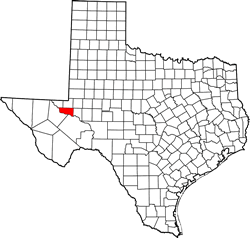
After selecting a site in adjacent Ward County southeast of Monahans
and not far from the Texas and Pacific main line, Roxana brought
in an army of workmen to dig a giant hole. More men than the nearby
town could accommodate, the work force lived in tents near the job
site.
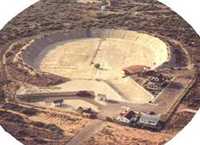
Using mule-drawn equipment, the workers completed an excavation
that from an airplane must have looked like a wide meteor crater.
Next workers laid wire mesh over the packed earth. Then, working
24-hours-a-day, contractors started pouring tons of concrete.
When the concrete cured, the tank measured 522.6 feet from north
to south and 426.6 feet east to west. With 45-degree walls, the
tank dropped 35 feet deep.
By late April 1928 workers hammered away at a wooden cover for the
colossal tank, placing creosote-soaked support timbers at 14-foot
intervals across the sprawling reservoir floor. Those timbers supported
a domed redwood roof covered with tarpaper.
Though the Monahans facility soon became
known as the million barrel reservoir, engineers had actually designed
it to hold a staggering 5 million barrels of oil. Pressurized crude
entered into the bottom of the tank, the intake located near a huge
drain that would be used to empty the tank in case of fire.
One thing Roxana’s engineers apparently forgot to take into consideration
was the weight of crude. One gallon of the thick stuff weighs nearly
eight pounds. A barrel of oil contains 50 gallons and weighs some
400 pounds. When Roxana injected a million barrels of oil into the
tank, the weight bearing down on the concrete amounted to 400 million
pounds of pressure.
Consisting of seamed sections of concrete, under that much pressure
the tank leaked. Beyond that, despite the roof, evaporation also
claimed oil.
Even so, the loss happened slowly enough to make the tank workable
for a time. The oil it did manage to hold got shipped by rail to
Oklahoma to be refined. But when production near Wink
began to decline, the flow from the field could be more easily moved
by traditional methods.
Not long after the economy soured following the stock market crash
in October 1929, Roxana stopped using its below ground Coliseum
without seats. In the early 1930s, the company removed and sold
the wood. According to Ben White, retired Monahans High School swim
coach and local history buff, quite a few board feet of the lumber
ended up in residences and buildings in Monahans.
The
huge concrete hole in the ground, wider than five football fields,
lay abandoned and mostly forgotten until 1954, when Monahans officials
tried to get the tank and land around it for a city park.
Shell nixed a lease agreement, but said it would sell the property.
The city opted not to buy it, but a former city employee named Wayne
Long did. He envisioned the tank awash with a fluid then even more
precious than crude oil – fresh water.
Long drilled six water wells to fill the tank, turned a cut that
had been made to remove the timbers into a boat ramp and transformed
the million-barrel oil reservoir into a million-barrel lake – the
most water they’d seen in one place since moving to West
Texas from Corpus
Christi in 1950. Their lake would be a place where people could
swim, ski and fish in the middle of a semi-desert.
For the lake’s grand opening in 1958, Long and his wife Amalie brought
in a pair of professional water skiers from Austin
to crisscross their new waterhole.
But water is twice as heavy as crude oil. The lake didn’t hold water
any better than oil and soon disappeared, along with all the money
the Longs had sunk into the project. Not a man to give up easily
Long spent a bunch more on engineering fees hoping to find and fix
the source of the leak.
Despite Long’s best efforts, tests showed the reservoir still leaked.
An attempt to transform the tank into an automobile race tract also
foundered. Finally, he gave up on a literal and figurative dry hole.
According to local lore, his failure sent him into an emotional
downward spiral that ended with his death of a heart attack in 1980.
Six years later, Amalie Long donated the tank and 14.5 acres around
it to the Ward County Historical Commission for use as a museum
complex and park. After nearly 60 years, someone had finally come
up with an idea that held water.
© Mike
Cox
"Texas Tales"
August 14, 2008 column
|
 HOME
HOME