|
Site
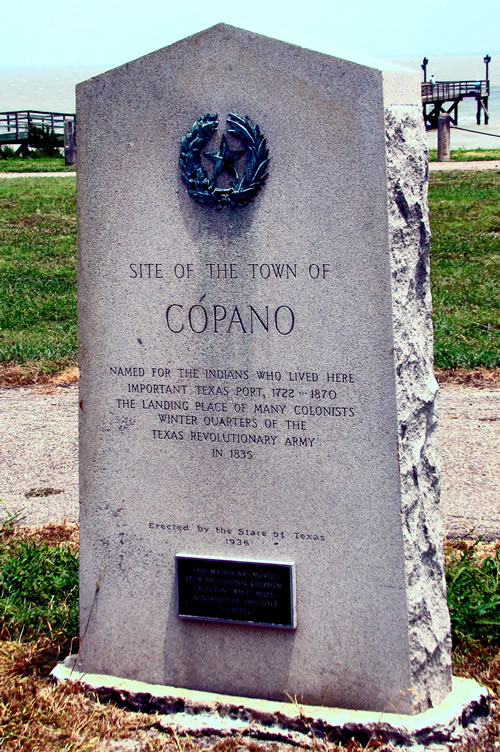
of the town of Copano, 1936 Texas Centennial marker
Photo courtesy Ken
Rudine, May 2007 |
History in
a Seashell
Known
as El Cópano by the Spanish and Mexicans, it was named after the Copane
Indians. It was used as a port in the early 1700s and was used by
smugglers and pirates. It was officialy declared a port of entry by
Mexican Governor Bernardo de Gálvez in the 1870s.
In the late 1820s and early 1830s Anglo settlers arrived here - including
Irish immigrants on their way to the Irish colony of San
Patricio. During the Texas Revolution it became a strategic point.
Mexican general Martín Perfecto de Cos landed his troops here prior
to advancing to Goliad
and Bexar. Shortly
thereafter Sam Houston
ordered that the point be defended and it was held until March of
1836, when it fell to troops commanded by Gen. José de Urrea. In May
of 1836, the Texans regained control of the port.
Settlement began around 1840 and by 1852 there was a small community
made up of a dozen homes. A post office was in operation from 1851
to 1867. At its peak, Copano had three warves and during the Civil
War the town prospered due to it's topography which made it had for
Union forces to monitor.
Finally in 1864 Union gunboats dropped anchor at Copano and the residents
fled inland, returning as soon as the fleet left. The town failed
to win a railroad connection and commerce was forced to take a long
and inconvenient route to Refugio.
Fresh water had always been a problem and eventually the townspeople
went to Refugio and never came back.
By the 1880s, the once promising port of Copano had become a ghost
town. |
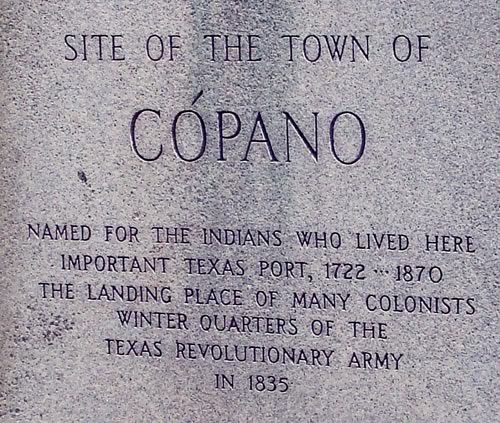 |
1936 Centennial
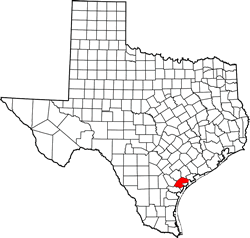
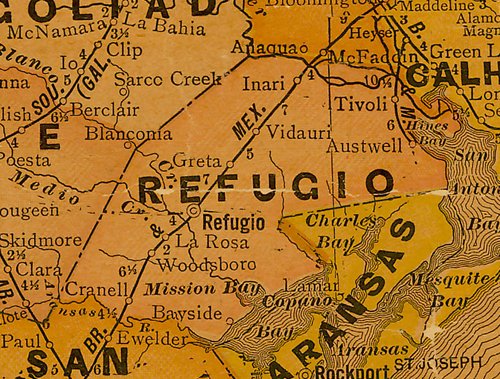
Marker: At Bayside public park, Copano Bay Street, Bayside
Site of the
Town of Copano
Named for the
Indians who lived here; Important Texas port, 1722-1870; The landing
place of many colonists; Winter quarters of the Texas Revolution Army
in 1835.
PROPOSED TEXT FOR SUPPLEMENTAL PLATE:
This marker was moved from its original location on Copano Bay (5
miles northeast of this site) in 1978. |
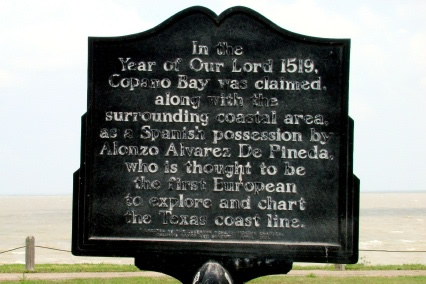
Copano
Bay marker
Photo courtesy Ken
Rudine, May 2007 |
| Texas
Escapes, in its purpose to preserve historic, endangered and vanishing
Texas, asks that anyone wishing to share their local history, stories,
landmarks and recent or vintage photos, please contact
us. |
|
|
 HOME
HOME