|
History in
a Pecan Shell
Now primarily known
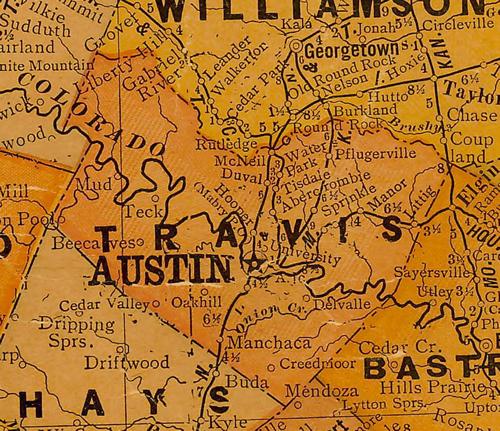
as an exit of Hwy 183, North Austin’s Duval Road once connected
Austin to the farming community
of Duval. Settled in 1875, it became a stop on the IG&N railroad and
was named for store owner Douglas Duval.
The importance of a railroad connection added weight to the community
and two years later, the smaller community of Mount Juliet
gave up its postal connection – allowing their post office to be moved
to Duval. The population of Duval in the mid 1880s was 75 residents
– served by three stores. The town “exported” stone and cedar – two
items that seem to be an inexhaustible resource in this part of Texas.
In 1890 the population had fallen to a mere 50 people and then to
just 35 at the close of the 19th century. The post office shut its
doors and mail was routed through McNeil
in 1902. The nearly forgotten town was annexed by Austin
in the mid-1970s. |
Footnote in
Duval's History
The more personal
history of Duval that follows was researched by Anna Galloway of Austin
who suggested Duval be included in our town pages. --Editor
"I was born in Brackenridge Hospital, Austin
and my parents lived on a farm that was the location of the former
town of Duval, Texas.
It was located adjacent to the IGN railroad where it formerly crossed
Duval Road in what is now North Austin. East part of Angus Valley
subdivision and all of the Champions Forest subdivision. At the entrance
to Champions Forest, Whispering Valley Road passes over where the
Mercantile Store stood.
“My father lived in [nearby] Merrilltown,
Texas... the family home stood where the water tank is currently
located to the west of Mopac toll-road. [He] and his dad saw the smoke
from a fire at Duval. He saddled up horses for himself and 2 or 3
sons and took tools to fight the fire. My dad said they were too
late as the Merchantile Store was the building that started the fire. A
strong wind had blown embers to the roof of each house in the small
town. All houses burned except one and it was later moved south of
its former location. The buildings owned by the railroad did not burn
nor did the depot and the post office. There were five other houses
located on small farms that did not burn. The depot was closed and
moved in the late 1920's or early 1930's. Post Office closed as well."
- Anna Galloway
Watters Park is another town in the vicinity that exists only
in name. Ms Galloway writes: “The spelling on the exit sign on Mopac
near the toll road part of Mopac has the name misspelled as “Waters
Park.” As of this writing, we’re unable to find any history for Watters,
Texas. - Ed |
 |
| Texas
Escapes, in its purpose to preserve historic, endangered and vanishing
Texas, asks that anyone wishing to share their local history, stories,
landmarks and recent or vintage photos, please contact
us. |
|
|
 HOME
HOME

 Texas
Gulf Coast
Texas
Gulf Coast East
Texas
East
Texas Central
Texas North
Central
Texas North Central
Texas South
Central
Texas South Texas
Panhandle
Texas
Panhandle South
Texas
South
Texas Texas
Hill Country
Texas
Hill Country West
Texas
West
Texas Texas
Ghost Towns
Texas
Ghost Towns Texas
Counties
Texas
Counties