|
|
Willow, Oklahoma:
The Real Texas
Or
Don't Mess with Oklahoma, Either!
Greer County, Oklahoma -
formerly Greer County, Texas
by John
Troesser
Book Hotel Here › Oklahoma
Hotels |
Don't
get upset about Texas losing territory - it happened a long time ago
and besides - if we got it back it would only ruin Texas' world-renown
silhouette.
For some reason the Bellville,
Texas library (which is nowhere near Oklahoma) has a copy of The
Willow Community 1898 - 1994: A History of the Pioneer Town in Greer
County, Oklahoma.
It's one of those history books that small towns get printed after
a lot of hard work, research and years of cajoling people into donating
photos from their family albums which never seem to get put back.
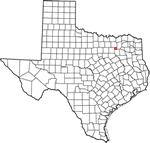
What caught our eye was Greer, County. This was one of Texas'
semi-notorious ghost
counties. "Ghost counties" were counties that were approved by
the State legislature but for one reason or another were never organized.
Usually it was blamed on a scrawny population. Greer County, Texas
was approved by the Texas Legislature in 1860 - 47 years before Oklahoma
statehood.
Oklahoma has always been a good neighbor - except for that little
bridge incident in the 30s when Oklahoma National Guardsmen and Texas
Rangers faced off on the Red River - but that's another story. Then
there's the story of Booker,
Texas that moved the whole town across the state line, but we
won't bring that up either. Anyway, Like a good neighbor, Oklahoma
is there.
Willow is the quintessential Texas small town - except for the fact
that it's technically in Oklahoma. It had the same incidents, disasters,
feuding, petty rivalry, and fights with the railroad as it's neighboring
towns in the Texas
Panhandle. Bank robbers in Willow were apprehended in Texas and
herds of Texas cattle stampeded in what would later become Willow.
Even
Temple Lea Houston - the original Son of Sam - settled
North of the Red River and is buried there in Oklahoma. |
The Eternal
Rival
Like any good small town - Willow had a rival. It's name was originally
Kell - but it was renamed Brinkman after a man who paid to
have the town platted.
Three miles South of Willow, Brinkman had the advantage of having
"the only grain elevator for miles."
The importance of grain elevators in Oklahoma cannot be overstated.
Both towns were on the railroad - but the main difference is - at
Brinkman the trains stopped. Children in Brinkman could watch the
show as the locomotive let off steam and took on water. Willow children
only got to wave to the engineer. |
How Willow
got their Depot - or -
The Day the Commissioner Nearly Got Hit by the 3:17
One day a county commissioner was visiting Willow and planned
his departure by flagging down the train. Evidently the engineer wasn't
impressed by the size of the crowd seeing the commissioner off or
else he didn't recognize a VIP when he saw one and sped right past.
The commissioner's face was as red as a brakeman's lantern. The next
Monday morning, carpenters arrived and started building a depot for
Willow. Never underestimate the embarrassment of petty bureaucrats.
Willow had its economic setbacks, too. In 1920 a fire consumed all
the wooden buildings downtown and the wooden parts of brick buildings.
The townsfolk immediately set to work cleaning the bricks so they
could be reused. Willow also experienced three robberies - or just
two if you don't count the time the crooks got only "small change
and mutilated currency."
Rivalry between Brinkman and Willow grew to become a full-fledged
(but bloodless) feud and when a letter to the editor was published
- touting the advantages of life and commerce in Brinkman, Willowites
gnashed their teeth. Adding insult to injury - they had to buy a Brinkman
newspaper to read the letter.
During statewide school consolidation - both towns refused to cooperate
to decide which of them would host the school district - this caused
them both to be swallowed by a third district. |
Father Time eventually
settled things by population attrition.
1910: -- Willow: 110
------- Brinkman 100
1930: -- Willow: 350
------- Brinkman 250
1950: -- Willow: 220
------- Brinkman 110
1960: -- Willow: 180
--------- Brinkman 20
Willow won the war, but the town had to swallow hard when it was included
in Ghost Towns of Oklahoma by John Morris in 1978.
Thanks to the efforts of the Willow Community Historical Association,
people (who have a copy) can look back to a time when everyone in
Willow with a motor vehicle brought it to Main Street for a picture
(two cars and two motorcycles). A time when people were Baptized in
farm ponds and during Prohibition the local still was known as "The
Buzzard Canyon Brewery."
So, now that you've been introduced to Willow, Oklahoma and some of
its history, we hope that you'll agree that it deserves to be included
in Texas towns and
please don't write the editor to complain. |
|
"Eightball,
We hardly Knew Ye"
Owen Milton "Eightball" Campbell
One of the non-family entries in the Willow, Oklahoma
history is Owen "Eightball" Campbell. Eightball was a Dallasite
who came to Willow after WWII
to visit an old Army buddy and never left.
The description of Eightball was written by a Willowite named Rex
Wall who described Eightball as a young Martin Van Buren. For readers
who can't immediately conjure up an image of Mr. Van Buren - he
was a portly gentleman who wore sideburns as big as bicycle mud
flaps. It was these sideburns (outrageous for 1946) which caused
people to ask Eightball: "Has anyone told you you look like Martin
Van Buren?"
Besides his 19th century tonsorial taste - he also wore no socks.
At first some people wondered "if it was safe to be around him."
Willowites, like most Oklahomans are sock-wearing people. The town
of Willow breathed a collective sigh of relief when it was explained
that he was from Dallas.
That explained everything.
Eightball worked for wages, sharecropped and did carpentry, plumbing
and electrical work. Nothing mechanical was foreign to him. He was
a jack-of-all-trades and as Mr. Wall describes his talents - he
modified farm equipment and improved upon its original design -
"usually with a cutting torch."
He converted a six-cylinder truck into an eight-cylinder vehicle
with little more than a Swiss army knife and a six-inch crescent
wrench. He modified his tractor with a guide wheel that would allow
his tractor to plow (albeit in circles) while he was having a beer
in town. One day he returned to his auto-tractor just in time to
see it sideswipe his 8-cylinder truck that was parked on the field's
perimeter.
Eightball was also an amateur radio operator and was known as "The
Voice of Willow." Exchanging postcards to verify contact with other
radio enthusiasts around the world also gave him the distinction
of being the person who bought the most stamps at the Willow post
office.
He served as Commander of the local American Legion Post from 1956
until his death in 1968.
Upon his death, Eightball's friends asked his family in Texas if
they would consider allowing Eightball to spend eternity in Willow.
The family agreed - after finally remembering just who it was these
people were talking about.
If you visit the Willow Cemetery today, you can't miss his tombstone.
It's the only one sporting a bowling ball with a large black eight
painted on a white circle.
© John
Troesser
October 2002
|
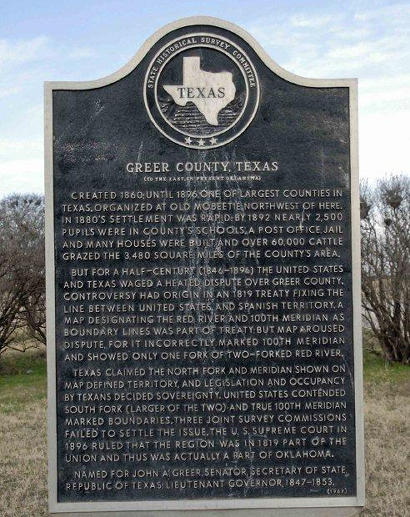 |
Greer County,
Texas historical marker
In Shamrock, IH 40, one mile west
of Oklahoma state line
Photo courtesy Rick
Vanderpool, 2010 |
Willow, Oklahoma
Forum
Subject:
Love It
I've just come
across your article about Willow, Oklahoma while researching my
dad's family. Because he passed when I was young I am always searching
for a personal connection beyond records and official documents.
Your article gave me that and I thank you!
I look forward to exploring your magazine further. My Davidson/Vance
side came to Texas via a Peter's Colony grant in the 1840s. I have
some photos I'd love to send in from those early Texas Davidsons
& Vances. Thank you again, - Pamela Davidson, March 03, 2019
|
| Texas
Escapes, in its purpose to preserve historic, endangered and vanishing
Texas, asks that anyone wishing to share their local history
and vintage/historic photos, please contact
us. |
|
|
 HOME
HOME

 Texas
Gulf Coast
Texas
Gulf Coast East
Texas
East
Texas Central
Texas North
Central
Texas North Central
Texas South
Central
Texas South Texas
Panhandle
Texas
Panhandle South
Texas
South
Texas Texas
Hill Country
Texas
Hill Country West
Texas
West
Texas Texas
Ghost Towns
Texas
Ghost Towns Texas
Counties
Texas
Counties