|
|
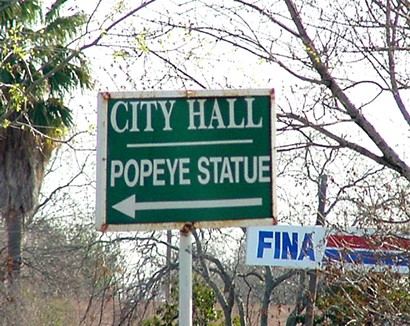
City
Hall Popeye statue sign
TE photo |
History
in a Spinach Can
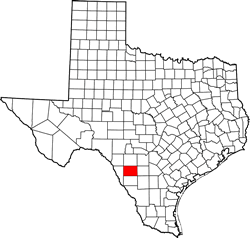
The counties of this region (other than the border counties) have
similar histories. Most towns were born with the arrival of the railroad
or when irrigation technology took advantage of the numerous wells
and springs.
Carl F. Groos and E. J. Buckingham, were developers who opened the
town in the early 1900s. They bought a 10,000-acre ranch in 1905,
platted the townsite of Crystal City and sold off land in smaller
parcels for farms.
In 1908 Crystal City was granted a post office and the Crystal
City and Uvalde Railway provided the first rail service.
In 1910 with a healthy population of 350 – the town incorporated.
An election held in 1928 made Crystal City the county seat.
The arrival of the railroad meant a market for produce and especially
winter vegetables for northern markets. Onions were the first crop
introduced, but spinach replaced the onion crop and now Crystal City
is “Spinach Capital of the World” |
|
|
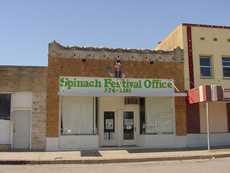
Crystal
City Spinach Festival Office
TE photo,
November 2002 |
The first annual
spinach festival took place in 1936 and the Spinach Festival maintains
an office in downtown Crystal City. The Spinach Festival was resumed
in 1982 after being suspended during World
War II.
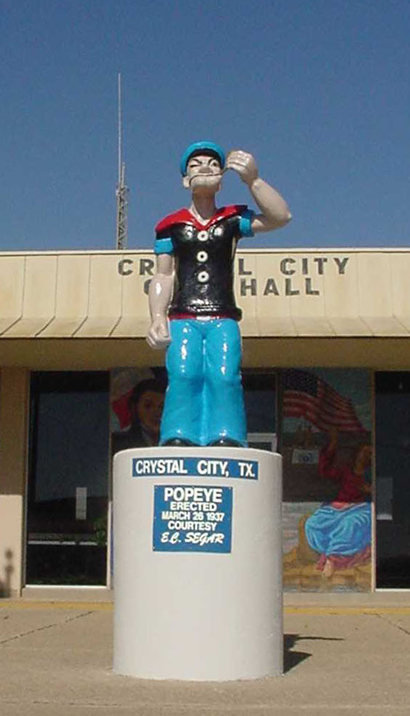
A statue of Popeye was erected with the blessing of the sailorman’s
creator in 1937. It ranks high in the pantheon of less-than-serious
statues in Texas. Today the pipe-smoking sailor stands in front of
city hall – sharing the same banishment of other tobacco users.
|
Crystal City
Attractions / Landmarks
|
| Photo
gallery with history: |
The statue of
Popeye in front of Crystal City City Hall
TE photo, November 2001 |
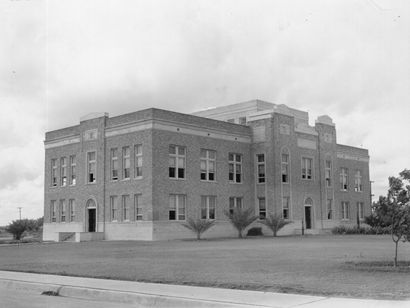
The 1928 Zavala
County Courthouse
1939 photo courtesy of TXDoT |
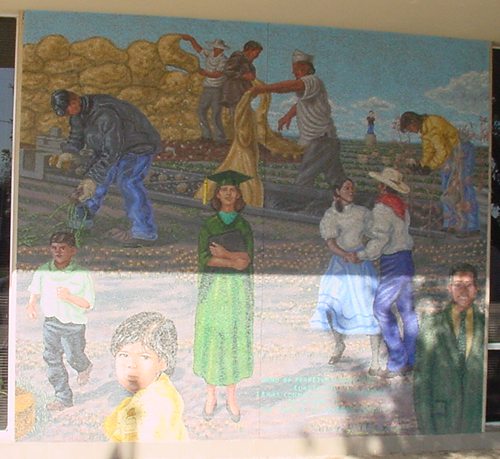
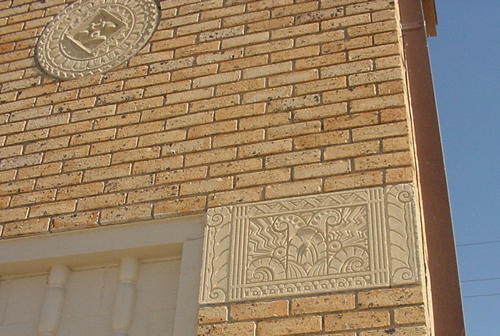
Mosaic mural
in Crystal City
TE photo, November 2001 |
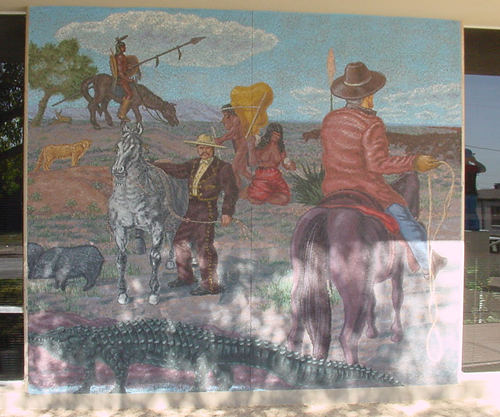
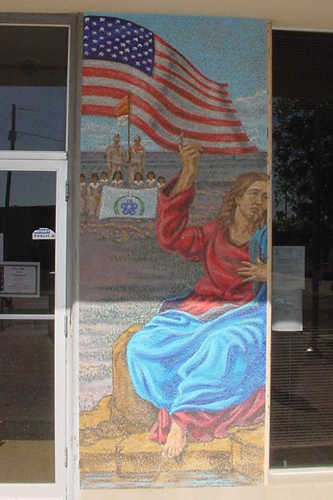
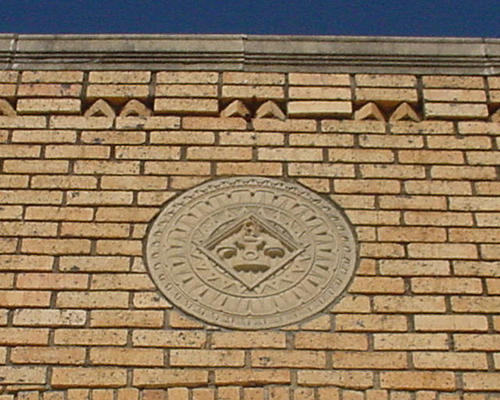
Another mosaic
mural
TE photo, November 2001 |
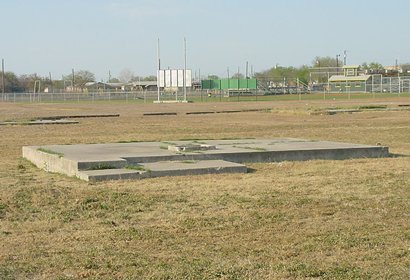
| Remains of the
U.S. Family Internment Camp. "This camp was used for the internment
German American, Italian American, and Japanese American families
during World War
II. The camp consisted of 649 buildings on 100 acres." -
Arthur Jacobs |
Historical
Marker:
Crystal City
Family Internment Camp,
World War II
When
the U.S. entered the war in 1941, an immediate fear was the possibility
of enemy agents in the country and the Western Hemisphere. As one
response, thousands of Japanese-Americans were moved away from the
West Coast. Lesser-known was an internment camp system operated by
the Immigration and Naturalization Service. The government built these
camps to hold Japanese, German and Italian nationals arrested in the
U.S. and Hawaii, and in Peru and other Latin American countries until
they could be exchanged for American detainees. Three of these camps
were in Texas at Kenedy, Seagoville
and Crystal City.
The Crystal City camp, converted from an existing migratory labor
camp, was the largest internment facility in the U.S. and the only
one built exclusively for families. The original 240-acre
camp later expanded to 290 acres, with
agricultural areas and support facilities. The primary living area
was a 100-acre compound enclosed by a 10-foot barbed wire fence, complete
with guard towers and spotlights. Like a small town, the compound
had 700 buildings and included family housing, schools, a hospital,
shops, warehouses, markets and recreation areas. Although intended
for Japanese, the Crystal City camp also held Germans and a few Italians.
The population averaged 2800 throughout the war. It reached a peak
of almost 3400 in December 1944, two-thirds of whom were Japanese.
At the end of the war, the government paroled internees throughout
the U.S. or sent them to their home countries. The Crystal City camp
was the only one still in operation by June
30,1947. It officially closed February 27, 1948, and the property
transferred to the city and school district.
Texas in World War
II, V+60
(2005)
TE Webmaster's Note:
Above numbers in red indicates corrections
by Mr. Werner Ulrich - past internee, and manage/administrator of
facebook’s U.S. Family Internment Camp, Crystal City, Texas |
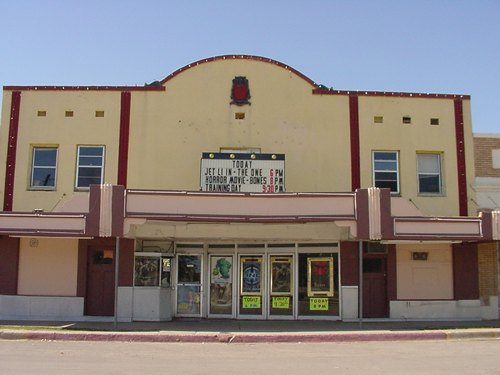 |
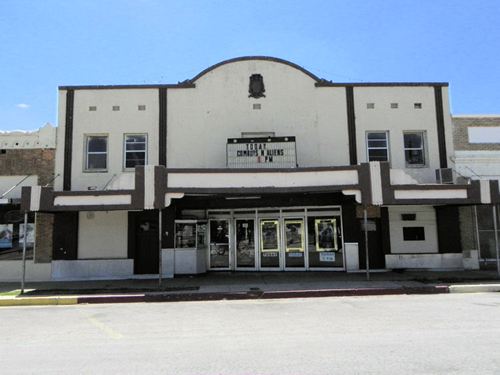
The theatre in
downtown Crystal City
TE photo, November 2001 |
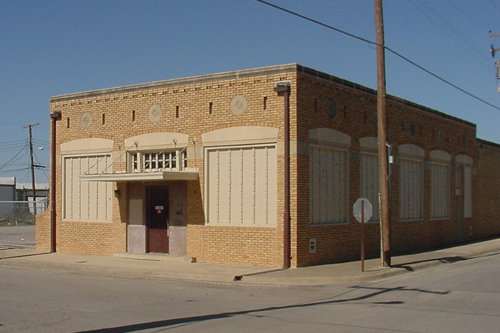
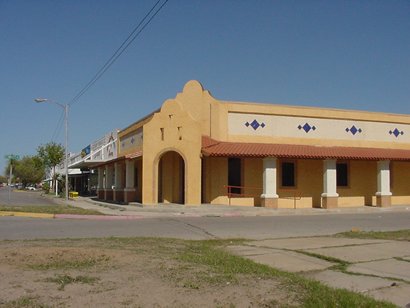
Crystal City
Telephone Building
TE photo |
Telephone Building
TE photo, November 2001 |
Telephone Building
TE photo, November 2001 |
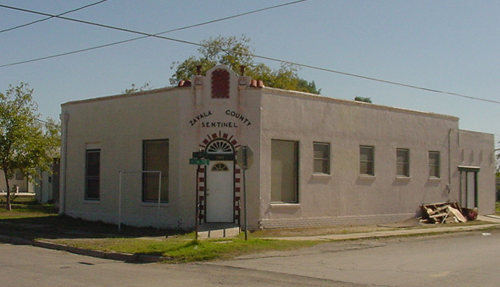
Zavala County
Sentinel Building
TE photo, November 2001 |
Alamo motif commonly
found in Texas architecture
TE photo, November 2001 |
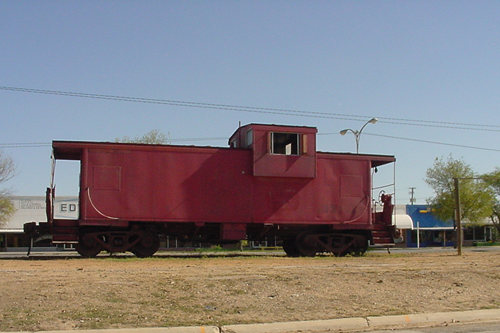
Caboose
TE photo, November 2001 |
The
Green Economy
The Del Monte Corporation is the county’s largest employee
and has been since it opened a canning plant in 1945 when it was operating
as the California Packing Corporation.
In the 1940s – an astounding 97% of Crystal City’s citizens were migrant
workers who followed the crops.
Del Monte’s operations and several expansions have helped increase
the town’s size. In 1950 the population that once left town to follow
the crops rose to over 7,000 and then to over 9,000 in 1960. |
The “Crystal
City Revolts” of the 1960s
In
the 1960s the Hispanic majority asserted their dominant voting power
to win key city and school offices. The exaggerated "Crystal City
Revolts"- which were peaceful – helped form the Raza Unida party in
1970. The party dominated the town politically until the late 70s
when it dissolved into splinter groups. |
Crystal
City, Texas Forum
Ted
Hood of San Antonio defends the Spinach Capital of the World
- November 15, 2006
Subject:
Crystal City Texas
Dear TE, A local Little Rock newspaper has an article about Alma,
Arkansas putting up it's second Popeye statue. And they claim Alma
is "The Spinach Capital of the World." Now you and I know that isn't
so. May I use some of your Web-site material in rebutting their
article? If this is not permitted, I may write them, using my personal
knowledge, having been born at Fort Sam Houston, San Antonio, Texas,
September 12, 1922. My wife was born in Crystal City, in 1923, and
participated in two Spinach Festivals. - Ted Hood Sr., Little Rock,
Arkansas, November 07, 2006
|
| Texas
Escapes, in its purpose to preserve historic, endangered and vanishing
Texas, asks that anyone wishing to share their local history, stories,
landmarks and recent or vintage photos, please contact
us. |
|
|
 HOME
HOME

 Texas
Gulf Coast
Texas
Gulf Coast East
Texas
East
Texas Central
Texas North
Central
Texas North Central
Texas South
Central
Texas South Texas
Panhandle
Texas
Panhandle South
Texas
South
Texas Texas
Hill Country
Texas
Hill Country West
Texas
West
Texas Texas
Ghost Towns
Texas
Ghost Towns Texas
Counties
Texas
Counties