|
|
 |
The town of Independence, Texas is actually very much
alive - with a very active group of preservationists. But it is also
a historic ghost town complete with ruins, restored buildings, residences,
cemeteries and over 30 points of historical interest.
The town once had an enviable head start over other towns of its era
and held enormous promise of being one of Texas'
cultural centers, despite not being a port, crossroads or having a
railroad connection. It did manage to become the wealthiest spot in
Texas during the days of the Republic.
Independence received two death blows - or three if you count not
being elected county seat. The other two were: being bypassed by the
railroad and the loss of Baylor University when it moved in 1886.
|
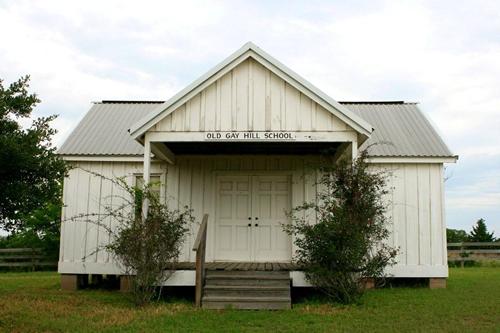 |
Independence
Early History:
Independence
was originally called Coles Settlement or Cole's Hill
after early settler John P. Coles. Coles was the Alcalde under Mexican
rule and one of the first to venture west from Washington-on-the-Brazos.
Coles was also the county chief justice when Washington
County was established in 1841. Coles once rented a cabin to a
Mr. Albert Gallatin Haynes, who is worth mentioning if only because
he named his sons Tom, Dick and Harry. Other settlers arrived from
North Carolina, Alabama and Kentucky including Nestor Clay - a nephew
of Henry Clay.
With the organization of Independence Academy in 1837 people started
applying the name to the town as well. Other sources credit Dr. Asa
Hoxey with naming the town. Hoxey is also credited with naming nearby
Washington.
In 1844 an election for county seat was held with four contenders
- the then county seat of Mount
Vernon, Turkey
Creek, Independence and Brenham.
Brenham won by a few votes - having just been renamed in honor of
a popular doctor who was killed in the ill-fated Mier
Expedition in 1842. Brenham also had the advantage of being more
centrally located. Turkey
Creek and Mount
Vernon disappeared without a trace. |
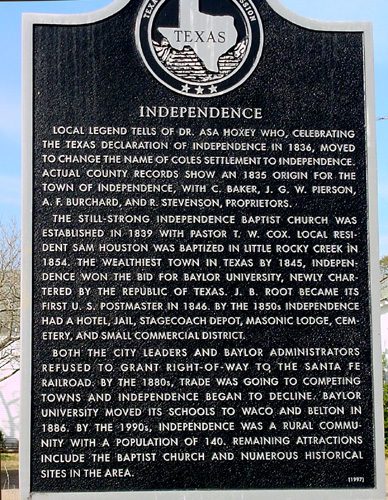 |
Independence
Historical Marker in town square
TE Photo |
Historical
Marker:
Independence
Local
legend tells of Dr. Asa Hoxey who, celebrating the Texas Declaration
of Independence in 1836, moved to change the name of Coles settlement
to Independence. Actual county records show an 1835 origin for the
town of Independence, with C. Baker, J. G. W. Pierson, A. F. Burchard,
and R. Stevenson, proprietors.
The still-strong Independence Baptist Church was established in 1839
with Pastor T. W. Cox. Local resident Sam
Houston was baptized in Little Rocky Creek in 1854. The wealthiest
town in Texas by 1845, Independence won the bid for Baylor University,
newly chartered by the Republic of Texas. J. B. Root became its first
U. S. Postmaster in 1846. By the 1850s Independence had a hotel, jail,
stagecoach depot, Masonic lodge, cemetery, and small commercial district.
Both the city leaders and Baylor administrators refused to grant right-of-way
to the Santa Fe Railroad. By the 1880s, trade was going to competing
towns and Independence began to decline. Baylor University moved its
schools to Waco
and Belton in 1886. By the
1990s, Independence was a rural community with a population of 140.
Remaining attractions include the Baptist church and numerous historical
sites in the area.
(1997) |
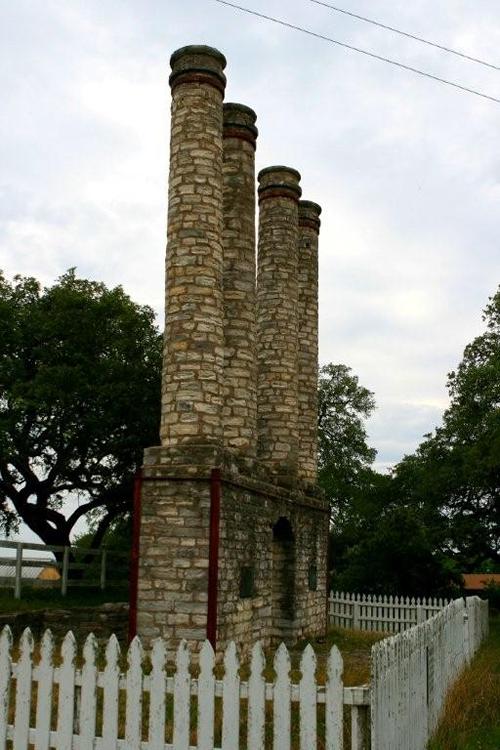 |
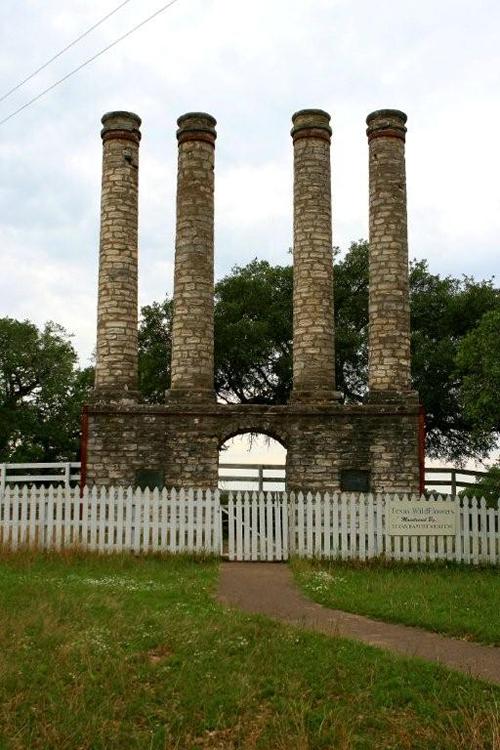
Old Baylor Ruins.
Columns in Old Baylor Park
Photo courtesy Stephen
Michaels, 2008 |
Old
Baylor Park
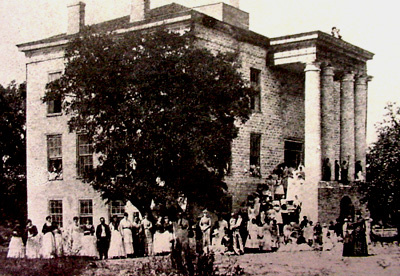
The Founding of Baylor
A Baptist church was established in September 1839
and shortly thereafter (1846) Baylor University was founded. During
the first few years the school was coeducational but after 1851 the
students were separated by gender.
The four impressive columns to the right of town in Old Baylor Park
are the rebuilt columns of the female Department of the University.
The Male Campus was located on Windmill Hill.
The stream in between the two campuses was lightheartedly referred
to as The River Jordan - since the females (at least in the minds
of the boys) dwelled in "the promised land."
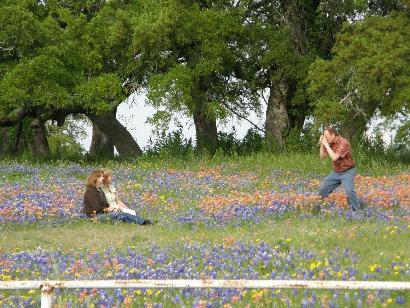
[ Friday
Afternoon in Spring at Old Baylor Park › ] |
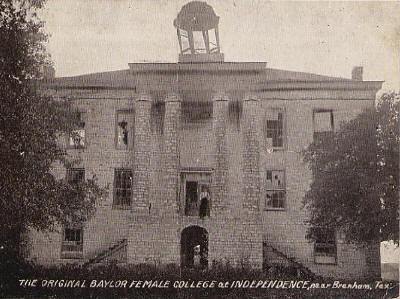
The original
Baylor Female College, early 1900s
Photo courtesy texasoldphotos.com |
| Baylor Female
College in Independence |
|
|
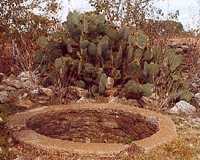
The
well of the former Baylor kitchen
TE photo |
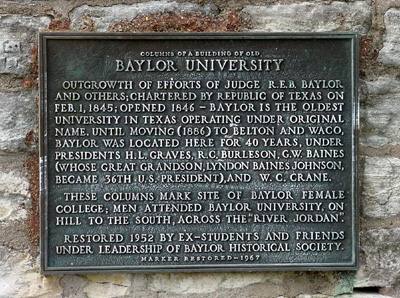
"Columns
of a Building of Old Baylor University" Marker
TE Photo |
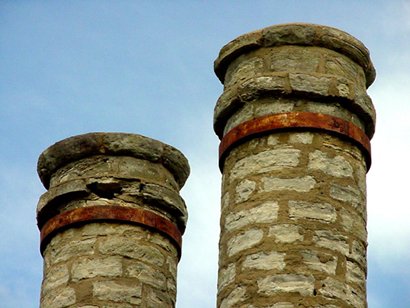
Baylor
Female College column remains in Old Baylor Park
Photo courtesy Stephen
Michaels, 2008 |
|
Windmill
Hill and Recent Improvements
Recent improvements on Windmill Hill include a walking path generously
landscaped with native plants and a new generation of live oaks,
an observation tower and the former foundations of the school.
Much of the stone of the abandoned institution was appropriated
by remaining Independence residents and it remains "on permanent
loan" in many local buildings.
|
|
|
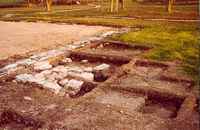
Excavations
of the former male dormitory on Windmill Hill
TE photo |
|
|
Former
stage stop
(Private property)
TE photo |
A
well has been re-excavated and lighted for the benefit of twilight
visitors. The lighting offers a good look at the substantial limestone
shelf the well diggers had to break through.
Visitors can orient themselves by using old photographs (transferred
onto metal) provided by Baylor University.
Across the street from Windmill Hill is the former home (c. 1845)
of General Jerome B. Robertson - Captain in the Army of the Republic
of Texas, Captain in the Somervell Expedition and Brigadier General
of Hood's Brigade, C.S.A. The house has been saved by an owner willing
to wait for a buyer who will faithfully restore the property. |
Independence
Cemetery
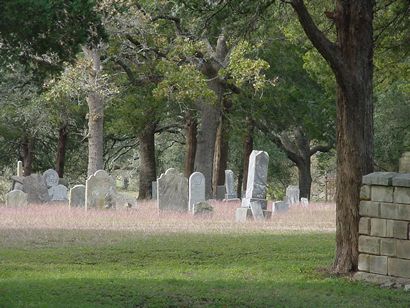
Eight
tenths of a mile North of the columns in Old Baylor Park on Coles-McCrocklin
Road is the Old Independence Cemetery which dates to the 1820s. Family
plots include the Clay and Coles families. Many inscriptions of places
of birth show the geographical diversity of the early settlers. The
setting of the cemetery surrounded by live oaks, pastures and ponds
deepens an already strongly-felt timelessness. |
 |
The Houston
Family as Residents
Sam Houston lived in Independence after serving as Senator from
Texas in the United States. He rented a house not far from the Old
Baylor Ruins and left his mark in the local church where a pew still
exhibits damage from his hobby of whittling during sermons - a once
popular past time that is frowned upon today.
Houston was also Baptized in Independence - on November 19, 1854
- not in the church as planned, but in Little Rocky Creek - between
Houston's house and the church. Legend has it that young pranksters
learned of the impending Baptism and clogged the ceremonial font
with mud and debris the night before.
Margaret Lea Houston - Sam's third wife is buried in Independence.
She died of Yellow Fever in 1867 and law prevented her body from
being sent to Huntsville
to lie beside her husband. Her mother is also buried here.
Prior to the
Civil War a debate was held in Independence on the thorny issue
of secession. The debate (comprised of Baylor University students)
was won in favor of the Union. A 50-foot "liberty pole" was erected
and the U. S. flag unfurled, but within a short time the pole was
chopped down by the mayor of Independence (Tass Clay), reflecting
the feelings of the majority of citizens - debate or no debate.
Robert McAlpin
Williamson
Three-legged
Willie by Bob Bowman ("All Things Historical" Column)
"The Republic of Texas, which existed only a decade, had its
share of interesting characters. But few of them were as colorful
as Three Legged Willie, who passed away some 146 years ago...."
more
|
Independence
Bell Tower
TE photo |
©
John Troesser
Bibliography: Baylor at Independence: 1845-1886, Lois Smith Murray,
Baylor University Press, 1972 |
Independence
Notes
by John A. Gilmartin
Editor's Note: In our original text on Independence, we mistakenly
refered to John P. Coles as John P. Cole and former Mayor Tass Clay
as "Task" Clay. Our errors were noted by Mr. Gilmartin who wrote the
following letter:
First of all, I genuinely compliment you on the wonderful information
you have compiled and published on-line. The accompanying photographs
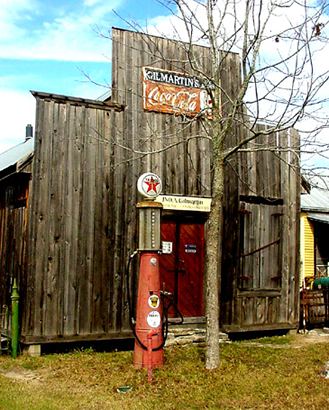
are excellent and I am honored that you included a shot of the old
General Store and Texaco Gas Pump that I own that is on the fringe
area of the original college site. I have owned property in the Old
Baylor Park at Independence the past 30 years. I was an officer and
member of the Independence Historical Society for many years and served
on the Executive Committee of the Washington County Historical Committee.
John Prince Coles who was born in Rowan County, North Carolina in
1793 emmigrated to Texas from Jasper County Georgia at Monticello
in 1820. He became a close and dear friend of Stephen F. Austin's.
Austin rewarded Coles' friendship, service and loyalty by insuring
that Coles received the largest land grants of all the original 300
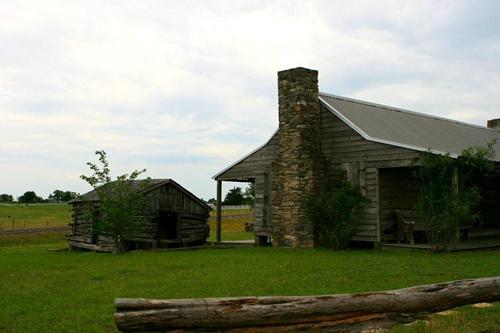
colonists. He arrived at Independence in 1822 and constructed his
"double-pen log house. Only one-half of it remains today. The south
one-half was destroyed by the 1900 Galveston Storm and was not rebuilt.Coles
also built and owned a Public House (Inn), constructed a mill on the
Yegua Tributary of the Brazos and was an original Trustee of Baylor.
Historically the town was known far and wide as Coles' Settlement.
After San Jacinto and the Texas Victory, Dr. Asa Hoxey led the movement
to change the town's name to INDEPENDENCE in commemmoration of Texas's
new independent status from Mexico. Coles died in 1847 and is buried
at the Old independence Cemetery. His widow Mary Eleanor had his tombstone
carved following his death.
The Mayor of Independence who chopped down the US Flag on the eve
of the Civil War was Tass Clay, named for the Roman Emperior Tacitus.
And in the Lea-Houston Family Cemetery, Margaret Lea Houston is buried
with her mother Nancy Moffette Lea and some former slaves. The Houston's
first-born son, Dr. Samuel Houston, Jr , is buried in the Old Independence
Cemetery. Again, thank you for your wonderful information and [magazine]!
Respectfully,
John A. Gilmartin,
Attorney at Law (Retired), Independence Local Historian, Crockett,
Texas |
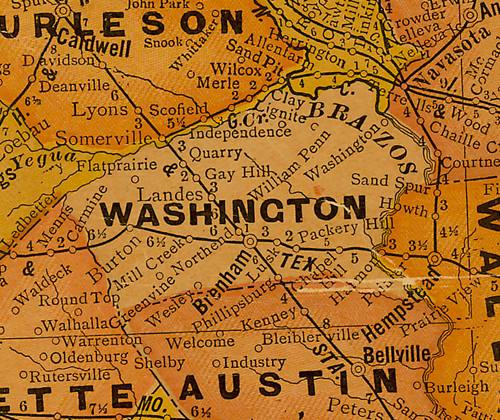 |
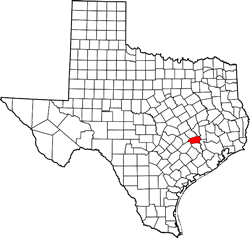
Washington
County 1920s map
From Texas state map #10749
Courtesy
Texas General Land Office |
| Texas
Escapes, in its purpose to preserve historic, endangered and vanishing
Texas, asks that anyone wishing to share their local history, stories,
landmarks and recent or vintage photos, please contact
us. |
|
|
 HOME
HOME

 Texas
Gulf Coast
Texas
Gulf Coast East
Texas
East
Texas Central
Texas North
Central
Texas North Central
Texas South
Central
Texas South Texas
Panhandle
Texas
Panhandle South
Texas
South
Texas Texas
Hill Country
Texas
Hill Country West
Texas
West
Texas Texas
Ghost Towns
Texas
Ghost Towns Texas
Counties
Texas
Counties