|
LLANO, TEXAS
"The Granite
City"
They use all they can and they sell the rest.
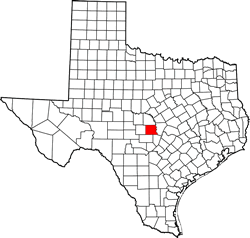
Llano County Seat, Texas
Hill Country
30°45'03"N 98°40'48"W
(30.750953, -98.680038)
State Highways 16, 29, and 71
FM 152
73 miles NW of Austin
30 miles W of Burnet
34 miles E of Mason
33 miles S of San
Saba
39 miles N of Fredericksburg
ZIP code 78643
Area code 325
Population: 3,347 (2020)
3,232 (2010) 3,325 (2000) 2,962 (1990)
Book
Hotel Here › Llano
Hotels |
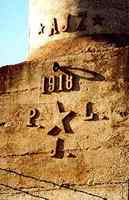
The date
at the ruins of the Llano Waterworks Smokestack
TE photo |
Downtown Llano
at dusk
TE Photo, August 2001 |
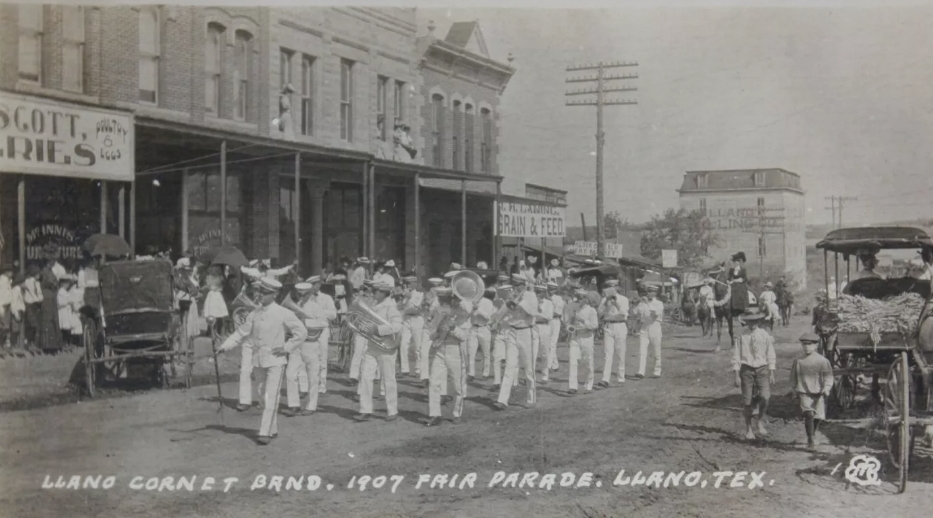
History in a Pecan Shell
Land donated by John Oatman, Sr., Amariah Wilson, and the Chester
B. Starks estate provided 250 acres for the county seat. The donated
land was on both sides of the Llano
River. The county was raided by Indians during the Civil War when
most of the men were fighting. Llano had a very high percentage of
votes for secession - which is evident by the Confederate statue on
the NE side of the square. |
A time line
of significant events in Llano history:
1856: Llano
County is established by the state legislature. A disputed election
that same year was held under a tree on the south side of the river
to determine the county seat of government. The losing faction were
residents of the Tow- Bluffton
region - north of present Llano.
1880s: The Llano Rural - Llano's first newspaper was published.
The second was The Iron City News. The Rural evolved amd merged into
other newspapers, including the Advocate, the Searchlight, and the
Gazette. Just after the turn of the 20th Century it became the Llano
News - the name it retains today.
1886 - 1893: Boom times for Llano when iron deposits were discovered
and investment money flowed.
1890s: Llano suffers a series of fires that were set for insurance
claims. Other businesses were consumed as well as when word got out
- insurance companies refused to sell Llano fire insurance for several
years.
1890: Population is said to have been 7,000 people
1892: Llano was incorporated, the Llano
River was bridged, and the Austin and Northwestern Railroad opened
a depot on the north side of the Llano
River. This was also the year the courthouse burned.
(See Llano County Courthouse)
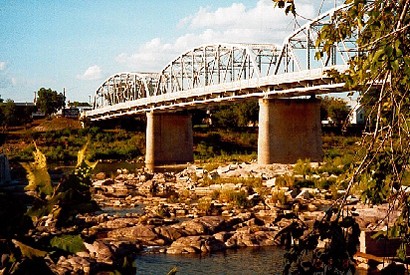
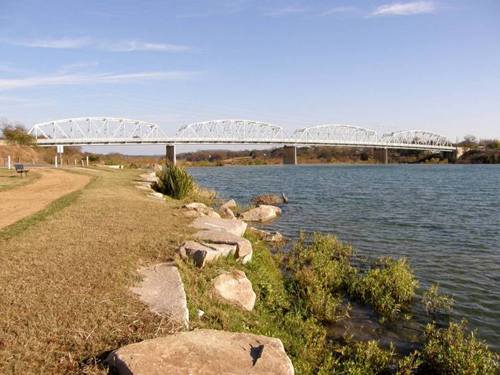
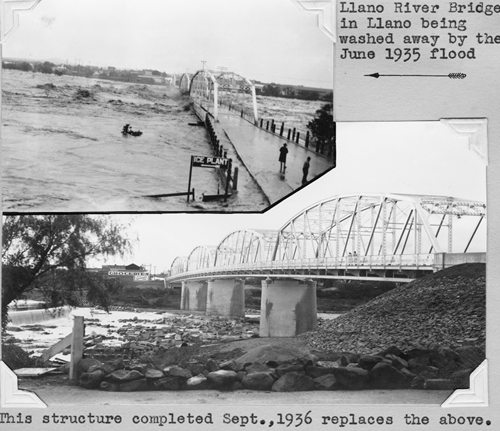
1935: The Roy
Inks Bridge was built after a flood
swept away the 1892 bridge. Photos of both the Algona Hotel fire
and the 1935
flood can be seen in the museum.
In the famous drought of the early 50s - the Llano
River actually went dry on two separate occasions.
1936: Llano
Gold by Mike Cox ("Texas Tales" column)
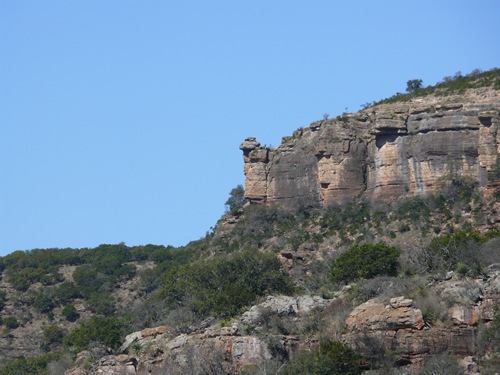
"Washed in golden sunset, from a distance Llano
County's Sharp Mountain looks like a giant Paleolithic flint hide
scraper lying on its side.
At 1,594 feet above sea level, the landmark barely deserves its mountain
designation. Its summit rising 400 feet above the land around it,
the huge pile of cedar-studded rock sits on private property about
five miles southeast of Llano. Few today know about the long-abandoned
mine shafts the mountain hides..." more
1954: The
Great Llano Uranium Boom by Mike Cox' ("Texas Tales"
column)
"Since Texas' time as a colonial outpost of the Spanish crown,
people have believed great mineral wealth lay hidden in what would
become Llano County..."
more |
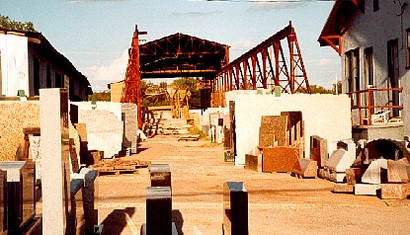 |
One of the several
working stone finishing plants around Llano
TE Photo, August 2001 |
1950s:
Granite production becomes a million dollar per year industry
Llano's Confederate soldier statue was made by noted sculptor Frank
Teich who was instrumental in establishing the Granite Industry in
Llano County.
German-born, Teich made a good living designing Confederate statues
for county governments across Texas and other southern states. He
also supervised the extraction and working of the stone for the state
capitol and several monuments on the grounds. |
|
|
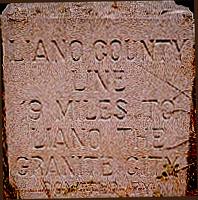
The
abundance of granite enabled Llano
County to have some elegant County Line markers - this one is
on the Llano/Gillespie county line on Hwy 16.
TE photo |
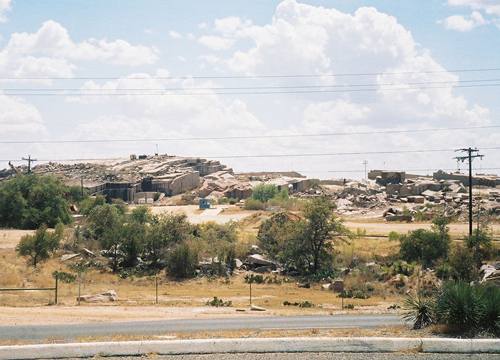
| Photo
courtesy Chia-Wei Wang, August 2006 |
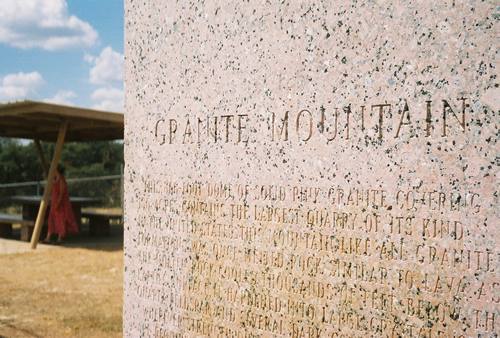
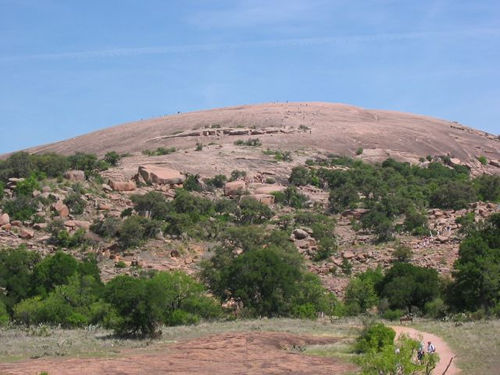
Granite
Mountain
Photo courtesy Chia-Wei Wang, August 2006 |
Llano nearly became a steel town when huge iron deposits were found.
The boom didn't last long, after someone noticed there was no coal
for smelting. Many streets in Llano have names that date from those
optimistic times.
Marble and granite production partially made up for the steel mills
that never materialized. Marble and granite was shipped all over the
U.S. until the railroad went up on their rates. Llano
County today continues to be trucked away daily by the ton. A
proposed railroad link to Fredericksburg
never made it off the drawing board, but there's little doubt it would've
been a boon to the economy of both towns. |
Llano, Texas
Landmarks / Attractions:
|
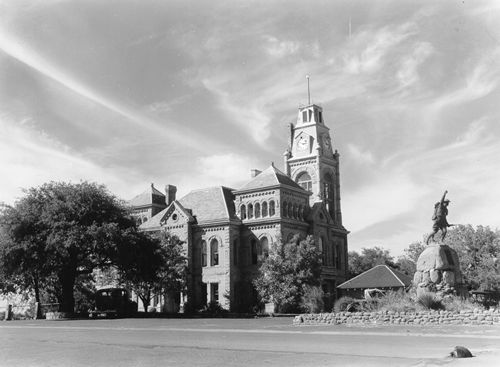
| 1939
Photo courtesy TXDoT |
Llano
County Courthouse
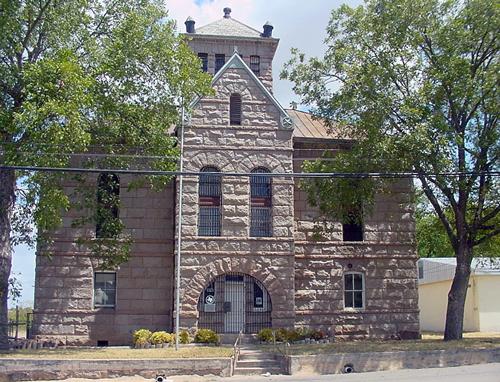
Llano
County Jail
Roy
Inks Bridge
Railroad
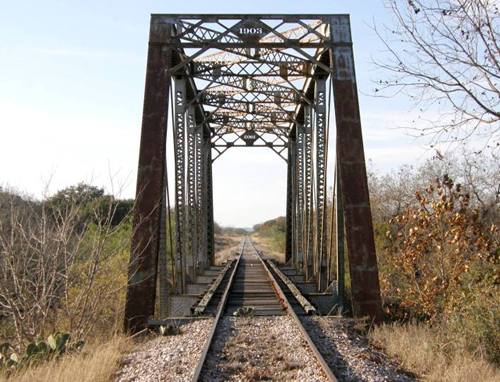
Through Truss Bridge
Badu
House - 601 Bessemer Street
Old Masonic
Lodge - 102 E. Main
Fraser House
- 207 E. Main
Historical
Museum - 310 Bessemer Street
The Masonic
Temple - 832 Ford Street
The Llano County
Library - 900 Ford Street
Old Ice House
- on the river on Berry Street
Llano Chamber of Commerce
Contact the chamber for a detailed walking tour of Llano.
700 Bessemer, Llano, Texas 78643 325-247-5354
Website: http://www.llanochamber.org/
|
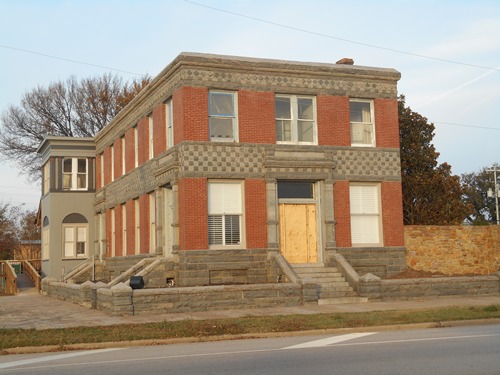
Badu
House
601 Bessemer Street
Photo
courtesy Michael
Barr, December 2017 |
|
|
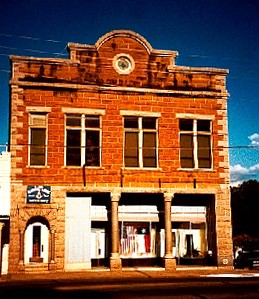
The
Masonic Lodge in downtown Llano
TE photo,
August 2001
More Texas Lodges |
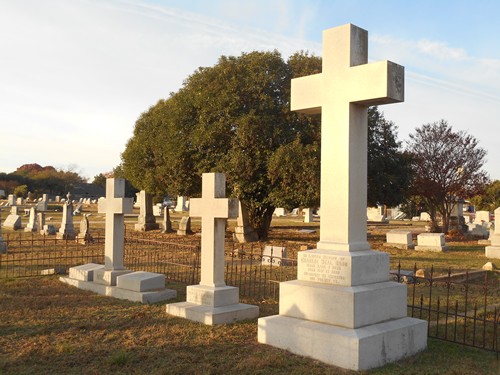
Llano
City Cemetery showing Badu
Family Plot
Photo
courtesy Michael
Barr, December 2017 |
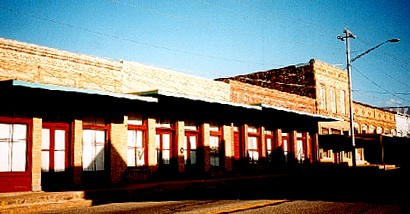
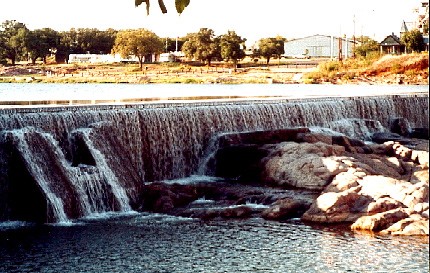
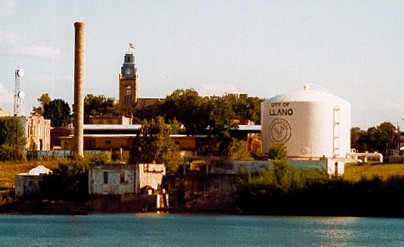
View
of Llano downtown across the river
TE Photo, August 2001 |
Claygate,
April 14, 2006
Wikimedia Commons |
 |
 |
Llano
Gold by Mike Cox ("Texas Tales" column)
The
Great Llano Uranium Boom by Mike Cox ("Texas Tales"
column)
Professor
Badu of Llano County by Michael Barr
Babe
Ruth of Polo by Michael Barr
The
Popularity of Polo by Michael Barr
Llano played polo as early as 1923. A trio of men from Llano County,
Cecil Smith, Rube Williams and York Ratliff were world-class players.
Llano County was renowned for its polo players and its breeding
and training of polo ponies. more
Rooms With
a Past:
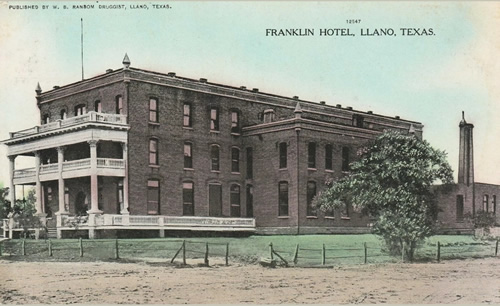
Llano suffered a fire in 1923 that destroyed a former landmark hotel
on the north side of the river - The Hotel Algona. The larger-than-it-needed-to-be
hotel was at one time the center for Llano society. The hotel changed
hands several times, and did business as the Hotel Franklin and
the Don Carlos. It was used by The Texas Military Institute for
a period before being damaged in a 1900 tornado. The fire of '23
was the final chapter in the Algona's life.
Llano's
Dabbs Hotel by Michael Barr
|
 |
| Texas
Escapes, in its purpose to preserve historic, endangered and vanishing
Texas, asks that anyone wishing to share their local history, stories,
landmarks and vintage or recent photos, please contact
us. |
|
|
 HOME
HOME