|
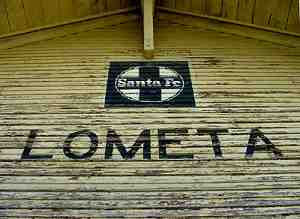
The name on Lometa's
Santa Fe Depot
TE photo, June 2002 |
History in
a Pecan Shell
Lometa was born
along the rails of the Gulf, Colorado and Santa Fe Railroad in 1885
on the route connecting Lampasas
with Abilene.
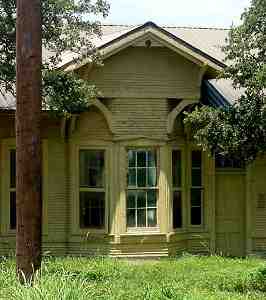
The old Santa Fe Depot (c. 1910) sits today at the North end of town
- awaiting restoration. This depot dated from 1910 - the year the
Santa Fe connected Lometa with Eden,
Texas.
The town had originally been called Montvale, but a change
was made in 1886 when a post office was applied for. Lometa was made
up of buildings moved from the town of Senterfitt - a town
that had a reputation for wild times and unruly citizens. 200 acres
of land were deeded to the town, which was platted May 17, 1886.
By 1890 there were 150 Lometans and four years later the town got
its first newspaper. Another weekly paper was published in 1896 and
a third by 1900.
The Scholton Railway was a short line railway established to haul
cedar posts for ranches in West
Texas. The historical marker for the railroad is south of town
- on the west side of highway 183. It ceased operation in 1920.
Lometa has served as a shipping point for cotton,
wool, and mohair. Delaine sheep were imported from Germany in 1879
and are still raised in the area.
Lometa received telephone service in 1914 and the town incorporated
in 1920. In 1919 the first oil well was drilled, but water was struck
instead of oil or gas. Other attempts failed as well, and by 1938
the drillers had given up on this part of Texas.
The population in the mid to late 1920s was 1,000 to 1,500 people
and in the 30s it dropped below 900. By the early 80s it had reached
about 650 and has remained at that level ever since. |
 |
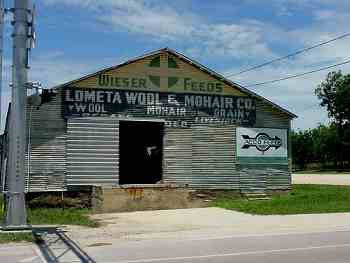
The feed store
at Lometa
TE photo, June 2002
More Texas Stores |
Lometa, Texas
Chronicles:
Salt
of the South by Clay Coppedge
The Civil War has been called by some historians "The War Between
the Salts" because salt was only slightly less important to the
Union and Confederate armies than ammunition.
The Union had plenty of salt but the South did not. As a result,
you might say that the North salted away the South. Or you may say
nothing of the kind.
Much of the salt used by the Confederate Army was produced about
eight miles south of where Lometa is now, at a place called Swenson
Salines. more
Little
Mysteries by Mike Cox
How did a German medal dated 1844 end up in a farmer's pasture near
Lometa in Lampasas County?
Kim
Stanley: Daughter of Texas by Maggie Van Ostrand
...Kim Stanley made very few films, and was nominated for the Oscar
for nearly every one... Born Patricia Beth Reid, she told different
stories about her origin, depending on her mood. In the rural Texas
version, she was born to a Baptist family on a farm outside of Lometa
in the hill country of Texas. She was not allowed to dance, listen
to the radio, or go to the movies, all considered instruments of
the devil... more
|
Lometa, Texas
Forum
I grew up on
a ranch south of Lometa near the ghost town of Nix
west of Lampasas.
As a kid I took a picture of an abandoned victorian mansion about
two miles south of Lometa. I lost the picture but Ive never been
able to forget that house. It was torn down many years ago but thought
perhaps someone may have information or a picture of it? It was
located on Co Rd 55 off Fm Rd 3415 off 183/190 south going towards
Lampasas. It was symmetrical in design with two big stone chimneys
& two turrets with steeples on each side of the house. A covered
porch with turned posts wrapped around the front of the house and
a balcony was over the top of the porch with a pediment front off
the center of the roof. There was lots of fancy woodwork, cut shingles,
etc. Not typical for most houses around Lampasas county! - Dave
Porter, August 20, 2010
A letter
from Johnnie Stokes:
.. In 1947 I worked at Lometa, Texas for the Colorado, Gulf and
Santa Fe railroad... The railroad hauled a lot of sheep and goats
out of Lometa in Spring and lots of wool and mohair in the fall.
more
Subject:
Lometa Texas John Stokes
I am E. L. "Poncho" Melvin Santa Fe Southern Division Santa Fe June
1945 through October 1990. Was telegraph operator. Found letter
from John Stokes very interesting. I am sure we broke him in at
Milano where Santa Fe crosses the IGN (Missouri Pacific). I worked
at Lometa in 1946 . The second trick man was L. G. Muncy and the
day man Fred Martin, the mixed train conducter was "Cedar Leg" Kegley.
I never worked at Blair but I did work at View. - Poncho, April
27, 2006
|
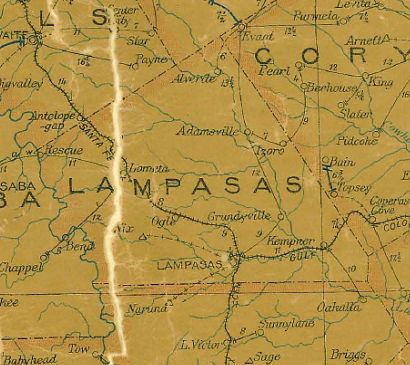 |
1907 Lampasas
County map showing Lometa and Santa Fe Railroad
From Texas state map #2090
Courtesy
Texas General Office |
| Texas
Escapes, in its purpose to preserve historic, endangered and vanishing
Texas, asks that anyone wishing to share their local history, stories,
landmarks and vintage/historic photos, please contact
us. |
|
|
 HOME
HOME