|
Home of "Jericho
Gap" of Route 66 Fame
by
Delbert
Trew
Jericho was founded in the late 1880s as a mail coach stop to change
horses and feed any passengers aboard. The faint tracks led across
bare prairie from Saint's Roost (modern day Clarendon)
to Fort Elliott (today's
Mobeetie). Composed
of a dugout with drinking water hauled in wooden barrels from a
nearby spring, settlers began to gather as the Indians were removed
to reservations after the Red River Wars ended in the late 1870s.
The Jericho Cemetery was established in 1894 after an unusual
outbreak of Malaria killed several settlers. The cause was traced
to stagnant water at the spring where drinking water was obtained.
Improvements to the facility were made eliminating the stagnant
water.
Construction started in 1900 on a railroad track built by the Choctaw,
Oklahoma and Texas Railroad Company. Most local settlers and
their stock teams worked on the construction project. The first
official train ran on July 6, 1902. Cattle loading facilities were
constructed to accommodate nearby large ranches and a huge water
storage reservoir was built by the railroad to refill steam engines
and provide water for people and livestock. Many of the settlers
came to the new settlement by emigrant cars pulled by the steam
engines.
Jericho became famous in legend and folklore after Congress authorized
a new coast-to-coast highway in 1926, calling it Route
66. Its passage through Jericho added prosperity with several
gas stations, stores and a motel built to serve the travelers.
The main reason for fame came from the stretch of highway between
Alanreed and Groom
which went through Jericho. Called "Jericho Gap" any rains caused
the dirt roads to turn into black-gumbo-mud becoming almost impassible
to the vehicles of the time. Nearby farmers made a good living with
their teams of work horses pulling the travellers from the mud holes.
Legend has it that the enterprising farmers hauled water at night
to dump in the mud holes to prolong their source of income.
With the railroad, Route 66 and well-traveled
Highway 70 going through their town, citizens of Jericho believed
their fair town was destined for greatness. In the 1930s, Route
66 was moved one-half mile north, by-passing the town and spelling
doom for its future.
Today, Jericho is a ghost town, with one occupied home amid scattered
ruins, cement foundations and piles of junk.
© Delbert
Trew
|
|

|
|
|
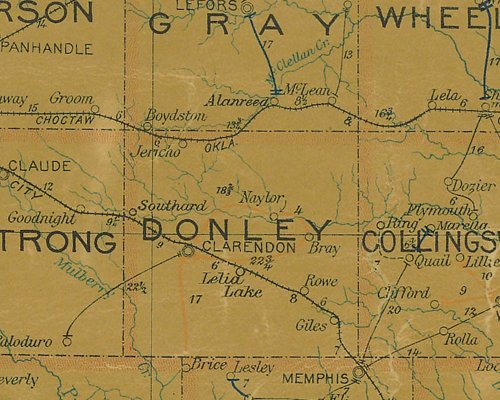
Donley
County 1907 postal map showing Jericho
NW of Clarendon
From 1907 Texas state map #2090
Courtesy
Texas General Land Office |
| Texas
Escapes, in its purpose to preserve historic, endangered and vanishing
Texas, asks that anyone wishing to share their local history, stories,
landmarks and recent or vintage photos, please contact
us. |
|
|
 HOME
HOME